
How to Self-Publish a Nonfiction Book: A Step-by-Step Guide
Self-publishing a nonfiction book can seem surprisingly simple at first.
Write the book. Upload it to Amazon. Pick a price. Hit publish.
Done.
Well… technically.
In reality, there are quite a few decisions between having an idea for a book and having it available for sale. I know because I have gone through the process myself more than once.
The good news is that you don’t have to figure everything out at once.
If you’re thinking about self-publishing your first nonfiction book, this guide will walk you through the major stages of the process—from choosing your topic to publishing and marketing the finished book.
1. Start With the Problem Your Book Will Solve
Before worrying about covers, ISBNs, Amazon categories, or other publishing details, start with the reader.
What does your reader need help with?
Nonfiction books generally work best when they have a clear purpose. Your book might teach a skill, answer questions, explain a complicated subject, help someone solve a problem, or guide a reader through a particular experience.
Instead of starting with:
What do I want to write about?
Try asking:
Who am I writing for, and what do I want this book to help them do?
For example, “I want to write about self-care” is extremely broad.
“I want to help overwhelmed caregivers find realistic ways to take care of themselves when they have very little free time” gives you a much clearer reader and purpose.
That distinction will affect almost everything that follows.
2. Research the Market Before Writing the Whole Book
You don’t need to chase trends or copy whatever happens to be selling.
You should, however, find out whether people are interested in your subject and what books are already available.
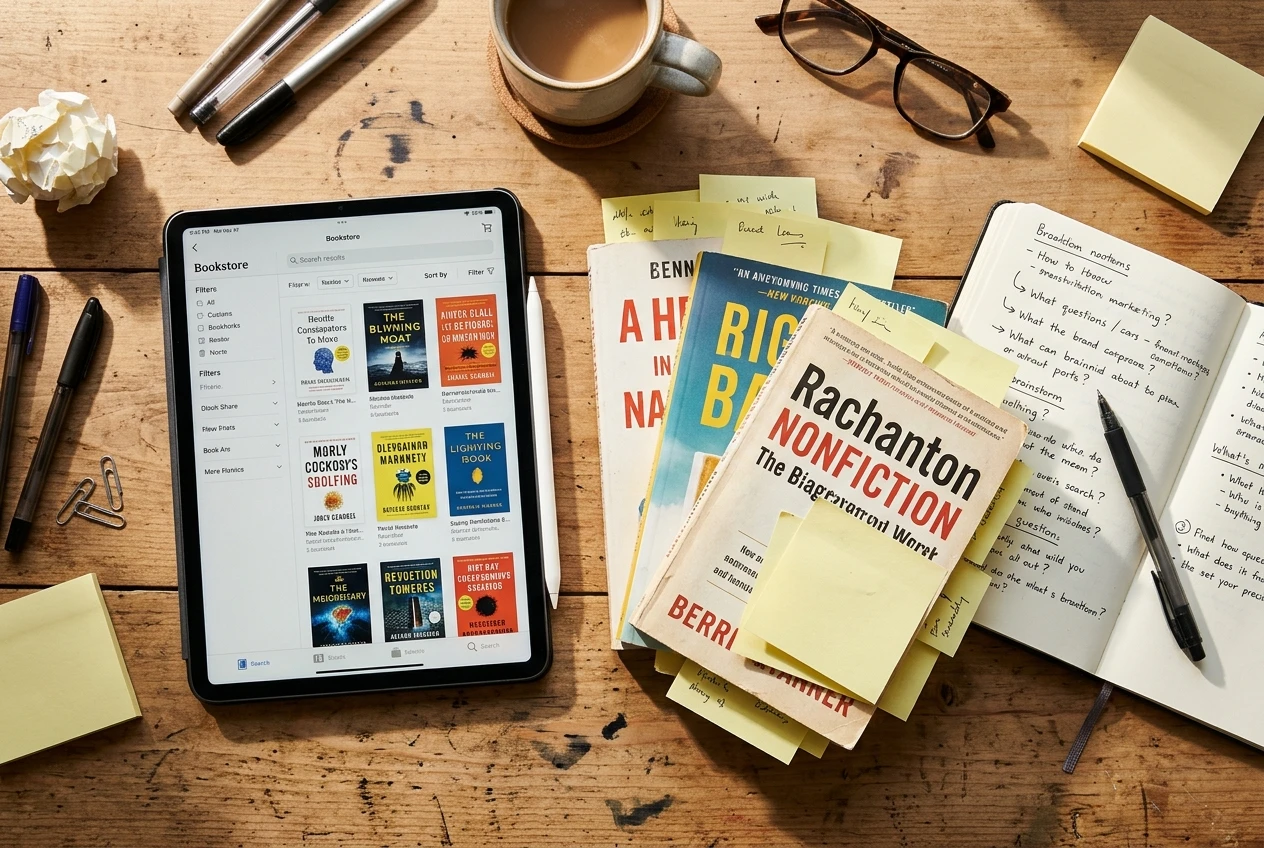
Search Amazon and other bookstores for books similar to the one you’re considering. Look at:
- titles and subtitles
- book descriptions
- covers
- table of contents when available
- reader reviews
- questions readers repeatedly ask
- complaints about existing books
Reviews can be especially useful.
If readers repeatedly say, “I wish this book explained…” or “This was helpful, but it didn’t cover…” you may have discovered something your own book could address.
The goal isn’t to find a topic with no competition.
No competition can sometimes mean no market.
Instead, look for a subject people are already interested in and determine what useful perspective, experience, or approach you can bring to it.
3. Define Your Ideal Reader
One mistake I made early in publishing was thinking too broadly about who a book was for.
It’s tempting to say:
This book is for everyone.
Unfortunately, books written for everyone often end up speaking directly to no one.
Picture one reader.
What are they struggling with?
What have they already tried?
How much do they know about your subject?
What questions are they typing into Google or Amazon?
What would make them pick up your book and think, Finally. This is what I was looking for.
You don’t need to create a complicated marketing avatar complete with your imaginary reader’s favorite breakfast cereal.
You simply need to understand the person you’re trying to help.
4. Decide What Your Book Needs to Cover
Once you know the reader and the problem you’re helping them solve, planning the book becomes much easier.
Start by listing the questions your reader needs answered.
Then organize those questions into a logical progression.
For a practical nonfiction book, that might look something like this:
Understand the problem → explore the options → choose an approach → take action → troubleshoot problems → decide what comes next.
Your outline doesn’t have to be permanent.
Mine rarely are.
As you research and write, you’ll probably discover sections that need to move, expand, or disappear completely.
That’s normal.
The outline is there to keep you moving in roughly the right direction, not to handcuff you to Chapter 7 because that’s where you originally decided something belonged.
5. Research Carefully
Your personal experience can make a nonfiction book much more relatable, but experience and evidence aren’t necessarily the same thing.
When you make factual claims, particularly about subjects such as health, psychology, finance, or other areas where inaccurate information could cause harm, use reliable sources.
Keep track of those sources while you’re writing.
Trust me on this one.
Trying to relocate a study three months later because you vaguely remember reading it “somewhere on the internet” is not an enjoyable afternoon.
Your own stories, examples, and experiences can then help explain the information and make it more useful to the reader.
6. Write the First Draft
Eventually, research has to turn into writing.
This is where many aspiring authors get stuck because they try to edit every paragraph as they write.
Your first draft doesn’t need to be beautiful.
It needs to exist.
You can improve awkward sentences.
You can reorganize chapters.
You can remove repetition.
You cannot edit a blank page.
Choose a writing routine that fits your life, not one somebody on social media insists “real writers” follow.
Maybe that’s 1,000 words every morning.
Maybe it’s 500 words three times a week.
Maybe you write in twenty-minute bursts whenever life gives you a chance.
Consistency matters more than having the perfect writing schedule.
7. Edit the Manuscript
Finishing the draft feels wonderful.
Unfortunately, it doesn’t mean the book is finished.
Now you get to discover how many times you explained exactly the same thing in slightly different ways.
Start with the big picture.
Does every chapter serve the reader?
Is information presented in the right order?
Are there gaps?
Have you included material that’s interesting but doesn’t really belong in this book?
Once the structure works, move into sentence-level editing for clarity, grammar, repetition, and readability. For More information on editing, read my article How to Self-Edit Your Manuscript Before Publishing
Depending on your budget and the type of book you’re publishing, you may also work with professional editors, proofreaders, or beta readers. To learn more about setting your budget and planning, read my article, How Much Does It Cost to Self-Publish a Book? A Realistic First-Book Budget
Outside feedback can be extremely valuable because after you’ve read your own manuscript seventeen times, your brain becomes remarkably talented at seeing what you meant to write.
8. Choose Your Publishing Options
Amazon Kindle Direct Publishing (KDP) is one of the most common starting points for independent authors because it allows you to publish Kindle ebooks and print books and reach Amazon’s enormous customer base.
But Amazon isn’t your only option.
IngramSpark, for example, can provide access to broader book distribution channels.
You may decide to publish exclusively through one platform or use several services depending on your goals.
Before choosing, consider:
- ebook distribution
- print distribution
- bookstores and libraries
- printing costs
- royalty structures
- international availability
- return policies
- exclusivity requirements
To learn more about choosing the best platform for you, read my article, Which Self-Publishing Platform Should You Use for Your First Book?
Don’t automatically choose the platform offering the highest percentage royalty.
A higher royalty on a book nobody can find isn’t necessarily the better deal.
Distribution matters too.
9. Format the Book Properly
Formatting isn’t particularly glamorous, but readers notice when it’s done badly.
Print and ebooks have different requirements.
A print book needs appropriate margins, trim size, headers, page numbers, and chapter formatting.
A reflowable ebook has to work across different screen sizes rather than behave like a miniature printed page.

You can format the book yourself using publishing software or hire someone to do it.
Either way, preview the finished files carefully before publication.
And order a print proof.
Please order the proof.
Something that looks perfect on a computer screen can suddenly develop a personality of its own once it becomes a physical book.
10. Create a Cover That Fits the Market
We all know the saying that you shouldn’t judge a book by its cover.
Readers apparently didn’t get the memo.
Your cover has an important job.

It needs to attract the right reader, communicate what kind of book it is, and stay readable when displayed as a tiny online thumbnail.
Look at successful books in your category.
You’re not trying to copy them. You’re looking for the visual language readers already associate with that subject.
Whether you create your own cover or hire a designer, make sure the final design works technically as well as visually.
For print books, that means considering the front, spine, and back cover—not just creating a pretty front image.
11. Write Your Book Metadata
Metadata sounds horribly technical.
It’s really the information that helps stores and readers understand what your book is.
That includes things such as:
- title
- subtitle
- author name
- book description
- keywords
- categories
- ISBN information
To learn more about ISBNs and meta data, read my article, Do I Need an ISBN to Self-Publish My Book? ISBNs and Metadata Explained
Don’t treat these as annoying boxes you need to fill in before Amazon lets you press Publish.
They influence how your book is discovered and how readers decide whether it’s relevant to them.
A beautifully written book with confusing positioning is much harder to sell.
12. Set a Realistic Price
Pricing involves more than looking at your printing cost and adding a few dollars.
Research comparable books.
Consider the format, page count, perceived value, printing costs, and expectations within your category.
Your ebook, paperback, and hardcover don’t necessarily need the same pricing strategy.
And remember that you can change your pricing later.
Very few publishing decisions are carved in stone.
That’s one of the advantages of self-publishing.
13. Publish—and Check Everything Again
Once you’ve uploaded the files, preview them.
Then preview them again.
Check:
- chapter headings
- page breaks
- margins
- images
- table of contents
- hyperlinks in ebooks
- author name
- title and subtitle
- book description
- categories
- keywords
- pricing
Once your book is live, open its store page as a reader would. Check that the cover, description, price, and available formats display correctly. If there’s a sample, open it and make sure it reads the way you expect.
14. Start Marketing Before You Need Sales
One of the biggest misconceptions about self-publishing is that publishing automatically creates visibility.
It doesn’t.
Millions of books compete for readers’ attention.
You can start laying the groundwork while you’re still writing or editing, even if your launch date is months away.
Marketing can include:
- your author website
- helpful blog content
- an email list
- social media
- Amazon advertising
- book reviews
- promotional opportunities
- collaborations
- podcasts or interviews
- reader communities
You don’t need to do all of these.
In fact, trying to be everywhere usually leads to spending an enormous amount of time creating content instead of writing books.
Choose a few marketing methods you can maintain consistently and build from there.
15. Keep Learning After Publication
Publishing isn’t the end of the process.
It’s where you finally get real information.
Are readers finding the book?
Are they buying it?
Which keywords are producing impressions?

What questions are readers asking?
Are reviews pointing to something that could be improved?
One of the things I appreciate most about independent publishing is the ability to make changes.
You can update descriptions, experiment with keywords, adjust pricing, improve covers and, when appropriate, release revised editions.
You don’t have to get every decision perfect the first time.
That’s fortunate, because very few of us do.
How Much Does It Cost to Self-Publish a Nonfiction Book?
There isn’t one correct number.
You can publish relatively inexpensively if you handle writing, editing, formatting, and design yourself. Costs rise when you hire professional editors, designers, formatters, or marketers.
The better question is:
Where will professional help make the biggest difference for this particular book?
If you have a limited budget, prioritize the areas you can’t confidently do yourself.
And don’t assume spending more guarantees sales.
It doesn’t.
How Long Does Self-Publishing Take?
Again, it depends.
Uploading a completed book can be relatively quick.
Creating a book worth publishing takes considerably longer.
Research, writing, editing, formatting, cover design, and proofreading all take time. Rushing those stages just to publish sooner usually isn’t worth it.
Set realistic goals and give yourself enough time to produce something you’re comfortable putting your name on.
Is Self-Publishing Worth It?
It certainly can be.
Self-publishing gives authors extraordinary control over their work. You decide what to write, when to publish, how the book looks, what it costs, and how you market it.
That freedom also comes with responsibility.
Nobody is standing behind you making sure the manuscript is properly edited, the cover fits the market, or your metadata makes sense.
You become both the author and the publisher.
That can feel overwhelming at first.
But you don’t need to master the entire publishing industry before you begin.
Learn the next step.
Do it well.
Then move on to the one after that.
Eventually, that document sitting on your computer really can become a book with your name on the cover.
And I can tell you from experience: that part never gets old.