How Fiction Authors Find Keywords That Actually Sell Books on Amazon
Fiction readers do not shop the way nonfiction readers do. Someone buying a book on sleep problems types “how to fall asleep faster” and expects a book to answer it. Someone who wants a novel types something closer to a mood, a trope or a half-remembered comparison: “grumpy sunshine romance”, “cozy mystery with a cat”, “space opera like The Expanse”. Keyword research for fiction authors means learning those phrases and checking which ones are worth building a book’s listing around.
This article covers the research workflow, from collecting phrases to scoring them and filling your keyword slots. It assumes you already know what the metadata fields are. If you need a refresher on those, the link at the end points to the right place.
Why fiction keywords work differently from nonfiction keywords
A nonfiction title can carry its keyword in plain sight. The subject is the product, so the search phrase and the book’s promise are nearly the same words. A novel has no such label. Its promise is an experience, and readers describe experiences with a mix of sub-genre names, tropes, settings, tone and other authors.
That changes what a useful keyword is. A single word like “romance” or “thriller” is too broad to win anything, because the books that already rank for it are the ones with the strongest sales histories. A useful fiction keyword is usually a phrase of two to five words that narrows the field to a group of readers who want exactly what your book delivers.
Three consequences follow:
- Genre names are the starting point, not the answer. “Fantasy” tells Amazon little. “Cozy fantasy with found family” tells it, and the reader, a great deal.
- Reader vocabulary beats author vocabulary. You may describe your book as a “character-driven literary mystery.” Readers may search “slow burn detective.” The words that match what they type matter more than the words that match your pitch.
- Keywords double as a promise. A phrase that attracts the wrong reader produces disappointed reviews. Only use a phrase if the book honestly delivers it.
Start with reader language: tropes, moods and sub-genre phrases
Before opening Amazon, write down what your book is, in the words a reader would use. Do this on paper or in a spreadsheet, and be generous. You will cut most of it later.
Sort your phrases into four groups:
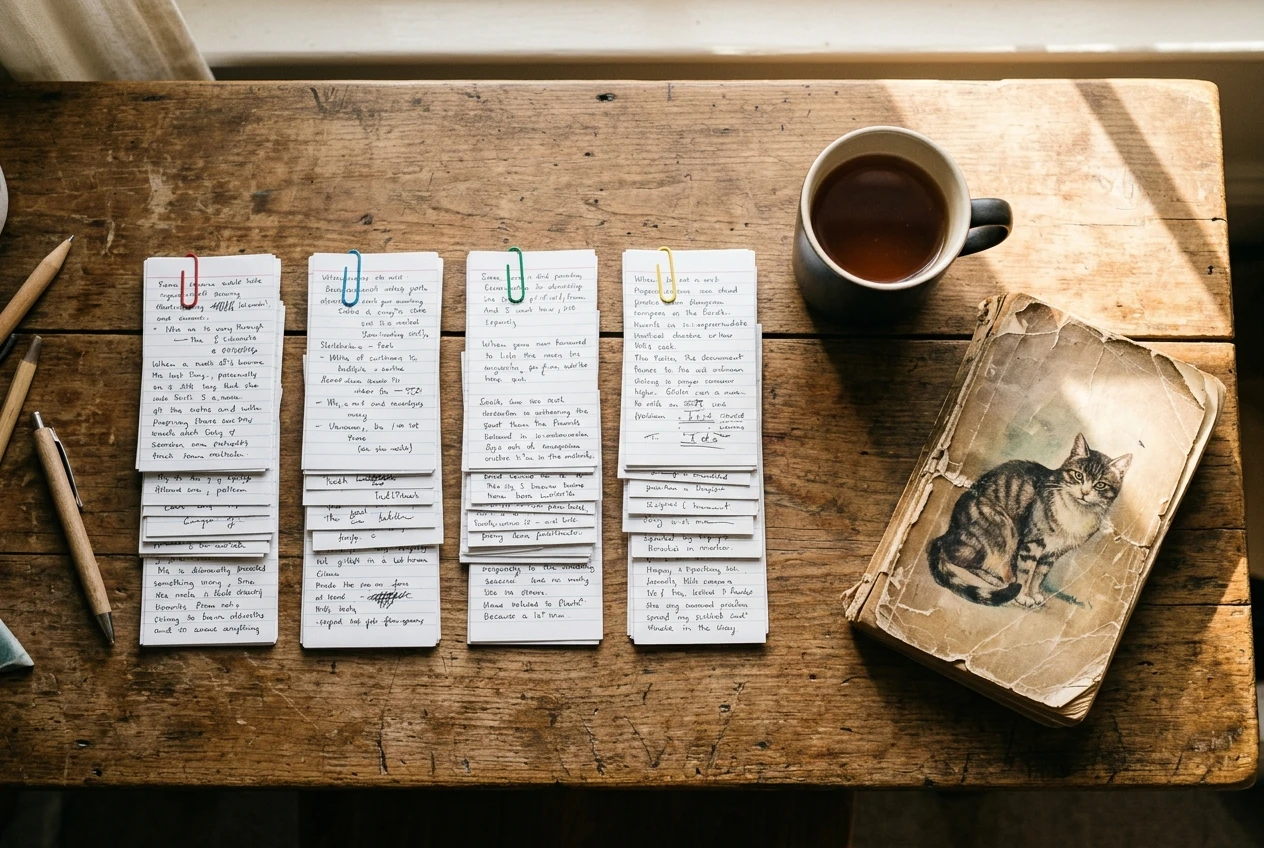
- Sub-genre. The shelf your book sits on: “paranormal women’s fiction”, “historical mystery”, “military science fiction”.
- Tropes. Recurring story patterns readers actively look for: “enemies to lovers”, “locked room”, “chosen one”, “second chance romance”.
- Mood and tone. How the book feels: “cozy”, “dark”, “witty”, “heartwarming”, “gritty”.
- Setting and character type. Where and who: “small town”, “Regency”, “female detective”, “dragon rider”.
Then combine across groups. A mood plus a sub-genre plus a trope gives you phrases like “cozy mystery amateur sleuth” or “dark fantasy anti-hero”. Most of the phrases worth testing are combinations of this kind.
A good source for the raw vocabulary is the reader side of the genre: the reviews on books similar to yours. Read the three-star and four-star reviews of five or six comparable titles and note the words reviewers use to say what they liked or expected. Readers describing a book to other readers produce the same language that shoppers type into the search bar. Write those words down exactly as they appear.
Keep honest limits on the list. If your romance has a happy ending but a bleak middle, “feel good” may attract readers who will resent the middle. Cross off phrases your book cannot back up.
Mining Amazon autocomplete without any paid tools
Amazon’s search bar suggests completions as you type, and those suggestions reflect searches that shoppers actually make. That makes autocomplete the cheapest demand check available, and it costs nothing.
Set the search to the Kindle Store or Books department first, so suggestions lean toward books rather than general products. Then work through your list from the previous section:
- Type the first few words of a phrase and note every suggestion that appears.
- Add one more word, or a letter, and note the new suggestions.
- Run through the alphabet after a seed phrase (“cozy mystery a”, “cozy mystery b” and so on) to surface variants you would not think of.
- Record each suggestion in your sheet, with the seed phrase that produced it.
A suggestion appearing at all is a signal that people type it. Position carries some information too, as higher suggestions generally reflect more common searches, though Amazon does not publish how it orders them, so treat position as a rough hint and not a measurement.
Pay attention to the phrases that surprise you. Authors often find that readers use a term for their sub-genre they had never used themselves, or that a trope has a shorter, more common name than the one they assumed. Those finds are the reason to do this work.
Do a second pass with your comparable authors’ names. Typing a well-known author in your genre followed by a space shows what readers pair with that name, such as “books like” patterns. Those suggestions show how readers think about adjacent titles, which helps you choose phrases that sit near the audience you want.
Autocomplete shows demand but says nothing about how hard a phrase is to rank for. That comes later in the process.
Reading the bestseller lists to spot what readers are buying
Autocomplete tells you what people type. The bestseller lists tell you what they buy. You need both, because a phrase can be searched often and still lead to books that have little to do with what you wrote.

Open the Best Sellers pages for the categories closest to your book and drill down into the narrowest sub-categories available. Look at the top twenty titles in each and gather the following:
- Title and subtitle wording. Authors who sell well in a sub-genre often use its key phrases in their titles and subtitles. Note which phrases repeat.
- Cover signals. Covers in a sub-genre tend to look alike on purpose. If the top titles all signal “cozy” visually, then “cozy” is a phrase readers in that space recognise.
- Blurb language. Open several product pages and read the first lines of each description. Hooks usually name the trope or the mood within a sentence or two.
- Category placement. Each product page lists the categories the book sits in. Collect the category names you did not know existed. Some of them fit your book better than the ones you had in mind.
- Comparable titles. The “customers also bought” and similar recommendation sections show which books Amazon connects to each other. If your closest comparables appear together, that cluster is your audience’s shelf.
Note any phrase that shows up in both the autocomplete results and the bestseller pages. A phrase that appears in both is searched for and also connected to books that sell, which makes it a strong candidate for your sheet.
Be wary of copying a bestseller’s wording wholesale. You are looking for the shared vocabulary of the sub-genre, and your own book still has to match the phrases you choose.
How to judge competition: a simple scoring check for any phrase
By now your sheet has dozens of candidate phrases. This check narrows them with the same questions every time, so your choices rest on evidence and not on instinct.
For each phrase, search it on Amazon in the Kindle Store, then score three things from 0 to 2. The scale below is a method for comparing phrases against each other. The thresholds are yours to adjust as you see how your genre behaves.
Demand (0 to 2)

- 0: the phrase does not appear in autocomplete.
- 1: it appears after you type most of it, or only with a variant.
- 2: it appears early, and variants of it appear too.
Relevance (0 to 2)
- 0: the first page of results is mostly books unlike yours.
- 1: some results match your book’s sub-genre, tone or trope.
- 2: most of the first page looks like shelf-mates of your book.
Competition (0 to 2, where higher is easier)
- 0: the top results are dominated by titles with very strong sales ranks, or by a few famous authors.
- 1: a mix of strong and modest sellers.
- 2: several results on the first page have modest sales ranks, showing that books without huge sales histories can place for this phrase.
You can read each product page’s Best Sellers Rank to judge the third score. A lower rank number means stronger sales. Compare ranks within your own genre and do not rely on a number from some other source.
Add the three scores. A phrase with 5 or 6 goes on your shortlist. A phrase that scores 3 or 4 is a maybe, and anything below that goes to the bottom of the sheet. Relevance acts as a gate: a phrase scoring 0 there is out, whatever its total, because it will attract the wrong readers.
The method also protects you from a common mistake, which is picking the phrase with the highest demand. High-demand phrases often have the toughest competition. A phrase that scores 2, 2, 1 is frequently a better bet than one scoring 2, 1, 0.
Choosing your seven keyword slots and matching them to your categories
Publishing dashboards give you seven keyword slots for a book. Each slot takes a phrase, not just a single word, so you can fit a full reader search into one.
Fill them from your shortlist with a few principles:
- Do not repeat words already in your title, subtitle or categories. Those fields already count toward discovery, so repeating the words spends a slot without adding reach. Use the slots for combinations that add something new.
- Spread across your four groups. Aim for a mix: a sub-genre phrase, two or three trope or mood combinations, a setting or character phrase, and one comparable-author or “readers of” style phrase where the platform’s rules allow it. Check the platform’s current guidelines on what you may include, since rules on author names and trademarks differ.
- Keep phrases that read as one search. “enemies to lovers workplace romance” works as a unit. A slot stuffed with unrelated words does not match anything a reader types.
- Match them to your categories. Your categories and your keywords should tell the same story. If your keywords say “cozy mystery with a cat” and your category is a broad thriller shelf, the signals conflict. Choose categories from the narrow sub-categories you found on the bestseller pages, and pick keywords that point at the same readers.
Write the final seven into your sheet with the score beside each. When you review later, you will know why each slot holds what it holds.
Using your keywords in the title, subtitle, blurb and ad targeting
The seven slots are only one place a phrase can do work. Your best phrases can also appear in the parts of the listing that readers see.
Title and subtitle. Fiction titles are rarely stuffed with keywords, and they should not read like search strings. A subtitle or series line is the natural place for a short sub-genre phrase, such as “A Cozy Mystery” or “A Slow Burn Fantasy Romance”. Use it only when it describes the book accurately. Your top-scoring sub-genre phrase is the best candidate.
Blurb. Work two or three of your best trope and mood phrases into the first lines of the description, in sentences that read naturally. The opening of a blurb is what shoppers see before they choose to read more, and it should name the experience in the words they use. Do not list keywords at the bottom. A blurb that sounds like a list reads as spam. For the craft behind the blurb itself, the site’s piece on how to write a book that sells covers what makes a story appeal to readers.
Ad targeting. Your shortlist is also a starting list for ad keywords. Phrases that scored well for demand and relevance are sensible first targets for keyword-based ads on Amazon, and the comparable titles and authors you found can serve as product or author targets. The site’s guide to social media advertising and promotion for new releases covers the other channels, which use the same reader language in a different format.
Keep the language consistent across all of these. A reader who finds the book with the phrase “cozy mystery with a cat” should see that phrase’s promise echoed in the cover, the blurb and the first pages.
Keeping a keyword sheet and revisiting it after launch
A spreadsheet turns this research into something you can reuse across books. Create one row per phrase, with columns for:

- the phrase itself
- the source (autocomplete, bestseller list, reviews, ad report)
- the demand, relevance and competition scores, and their total
- the date you scored it
- whether it is currently in a keyword slot, a title, a blurb or an ad
- notes on results
The date column matters because the market changes. Bestseller lists shift, new tropes become popular and competitors release into your sub-genre. A score from several months ago may no longer hold, so re-score a phrase before you rely on it.
After launch, give the book a few weeks of data and then review. Look at what your tools actually show:
- Your sales dashboard and category rankings show whether the book is placing where you expected.
- If you run ads, the search term report lists what shoppers typed before they clicked or bought. Those terms are real reader language, and they often include phrases you never listed. Add the good ones to your sheet and score them.
- Phrases that produce impressions but no sales may signal a mismatch with the book. Swap them out.
Change one or two slots at a time and note the date, so you can connect a change in results to a change in keywords. If you swap all seven at once, you will not know which swap helped.
Treat each new book as a chance to reuse the sheet. Sub-genre phrases and trope vocabulary carry across a series and often across books in the same genre, so your research compounds over time.
Your next step
Pick one book in your catalogue and run through the scoring check on five phrases this week. Then update its keyword slots with the best performers and record the change date in your sheet. If you still need to review how metadata fields work, start with Understanding ISBNs And Book Metadata.